How to Create a Landscape Design Base Map

Updated: May 3
How to Find Your House in Google Earth and Make a Base Map

Step 1: Open Google Earth
Go to Google Earth on your computer.
Use the search bar to type in your home address.
Google Earth will zoom to your property.

Step 2: Switch to a Top-Down View
Zoom in until you can clearly see:
Your house
Driveway
Sidewalks
Patio or deck
Yard edges
Existing trees or large shrubs
For the most accurate drawing, use a straight-down view. Google recommends top-down view for better measuring accuracy.
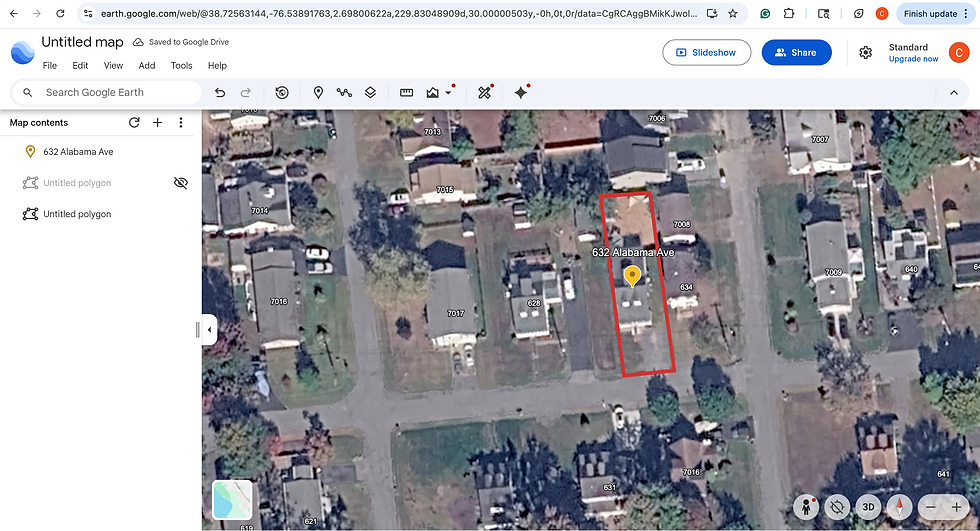
Step 3: Draw Your Property Boundary
Click once on one corner of your property.
Then keep clicking around the edge of your lot.
Follow visible clues like:
Fence lines
Driveway edges
Sidewalks
Property corners
Street frontage
To close the shape, click back on your first point.
Google Earth will show the area of the shape you drew.
Save your project.

Step 5: Outline the House or Building
On the tool bar, select the path/polygon tool.
Click around the outside corners of your house roofline.
Keep it simple. You are just creating a rough outline.
Include:
Main house shape
Garage
Porch
Deck or patio, if visible
Step 6: Save or Screenshot Your Map
Take a screenshot of your finished base map.
This becomes the starting point for your native garden design.

Step 7: This is Your Base Map, Start Designing.
Now you have a base map. You can print it. Trace it. Blow it up.
This is your “before” map—the foundation for the whole design.
Be a detective. Have fun and find the following:
Solar Direction
Sunny areas - Dry areas
Shady areas
Do you have solar panels (avoid tall tree planting)
Water
Wet areas
Water flow
Downspout
Gutterless roof with drip edge
Wind Direction
Sheltered areas
Exposed areas
Topography
Hills and slopes
Elevations
Existing structures
Decks
Driveway
Paths
Out buildings (sheds, saunas, etc.)
Xeriscaping or Zeroscaping
Fire remediation
Creating a fire break
Considering planting and hardscapes
Neighbors
Places of needed privacy
Places to keep open
Existing plantings
Garden beds
Trees
Schrubs
Grass
Now have fun. Find a Native plant nursery in your area, learn how you can conserve water using native plants and start planning.


Comments